

Space Maintenance
When a baby tooth comes out earlier than it should, the gap it leaves doesn't just sit there waiting. The teeth on either side start drifting into it — sometimes within weeks.
By the time the permanent tooth is ready to arrive, its space has been taken. It comes in crooked, comes in behind the others, or stays trapped in the bone entirely.
A space maintainer holds that spot open. It's a small appliance, it's far simpler than the orthodontic treatment it prevents, and for most children it's a quiet piece of insurance they barely notice after the first week.
When your child needs one
Not every early tooth loss needs one. It depends on:
- Which tooth was lost. Back teeth hold space that matters structurally. Front baby teeth mostly don't — losing an upper front tooth early is usually a cosmetic and speech question, not a space one.
- How old your child is, and how far the permanent tooth is from erupting. If the adult tooth is arriving in a couple of months, there's often nothing to maintain.
- How crowded things already are. A child with generous spacing has more margin than one who's tight to begin with.
We'll look at an x-ray to see exactly where the permanent tooth is sitting before recommending anything.
The Four Most Common Space Maintainers
Which one your child gets depends on where the gap is, how many teeth are missing, and which permanent teeth have arrived.
Band and loop
For a single missing back tooth, on one side.
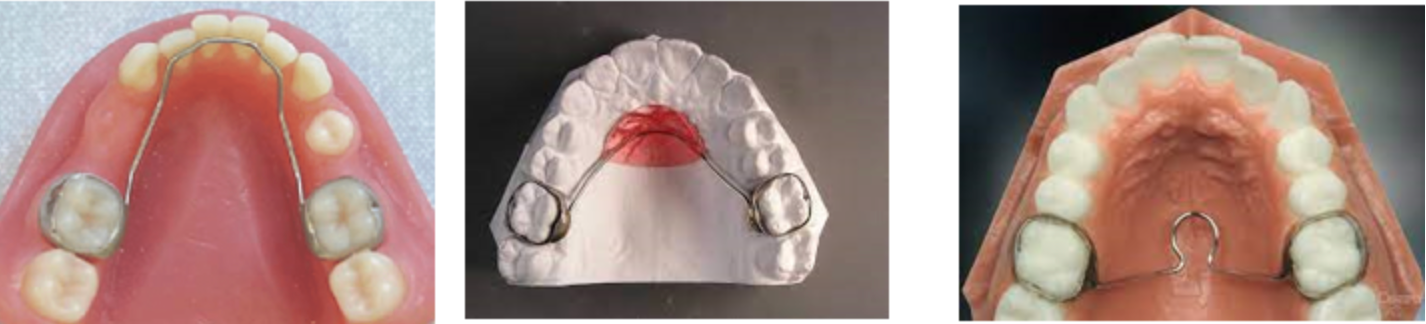
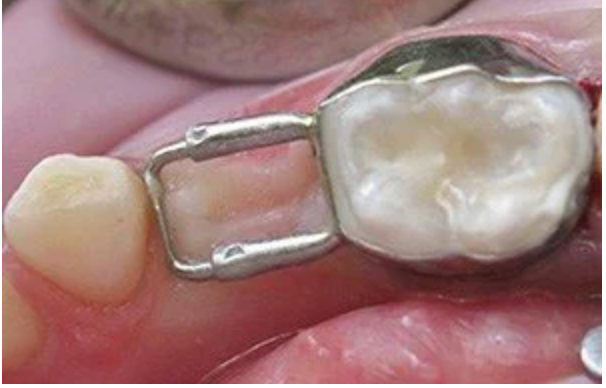
- This is the one we place most often. A thin metal band is cemented around the tooth on one side of the gap, and a smooth wire loop extends across the empty space to rest gently against the tooth on the other side.
- The loop acts as a physical blocker. Nothing can drift into the space because the wire is already occupying it.
- It's simple, small, and children adapt to it quickly. One thing to know: it holds the space but doesn't replace the tooth for chewing — there's no false tooth on it.
Distal shoe
For a second baby molar lost before the six-year molar has come in.
- This is the specialized one, and it solves a specific problem: if that back baby molar is gone and the first permanent molar hasn't erupted yet, there's no tooth behind the gap to anchor against. A band and loop has nothing to rest on.
- The distal shoe has a small blade that extends beneath the gum line, into the tissue where the permanent molar is developing. As that molar erupts, it comes up against the blade and gets guided into the correct position rather than drifting forward.
- It's the only appliance that can steer a tooth that hasn't emerged yet. We take an x-ray to position the blade precisely.
- Because part of it sits under the gum, we review your child's medical history carefully first — it isn't the right choice for children with certain heart conditions or compromised immune systems. Once the permanent molar has erupted, we typically replace it with a band and loop.
Lower lingual holding arch (LLHA)
For missing teeth on both sides of the lower jaw.
- Bands are placed on the lower back molars on each side, connected by a wire that runs along the inside of the lower teeth — the tongue side — and rests lightly behind the lower front teeth.
- That wire braces both sides against each other. The back molars can't drift forward because the arch holds them, and the overall length of the dental arch is preserved.
- It's one appliance doing the work of two, which is why we use it when your child has lost baby molars on both sides below. It's usually placed once the lower permanent front teeth have come in, since the wire needs those teeth to rest against.
Nance appliance
For missing teeth on both sides of the upper jaw.
- The upper-arch counterpart. Bands go on the upper back molars, joined by a wire that crosses the roof of the mouth to a small acrylic button sitting against the palate just behind the front teeth.
- That button is the anchor. It braces against the palate so the upper molars can't slide forward into the empty spaces.
- One thing worth knowing: because the button rests directly on the palate, the tissue underneath it needs good cleaning. Food can collect there and irritate the gum if hygiene slips. It's manageable — it just needs attention, and we'll show your child exactly how.
| Appliance | Where | Used when | How it holds space |
|---|---|---|---|
| Band and loop | One side, upper or lower | A single baby molar lost, with teeth on both sides of the gap | Wire loop physically fills the space |
| Distal shoe | One side, back of the arch | Second baby molar lost before the six-year molar erupts | Blade under the gum guides the erupting molar into position |
| Lower lingual holding arch | Both sides, lower | Baby molars lost on both sides below | Wire across the inside braces both sides and holds arch length |
| Nance | Both sides, upper | Baby molars lost on both sides above | Acrylic button braces against the palate |
Getting one placed
Usually one - two short visits, and neither requires numbing.
- First visit: we fit a band to the tooth and take an impression or digital scan. Your child bites into a soft material for a minute — that's the least popular part, and it's over quickly.
- Second visit: we try the finished appliance, check the fit and the bite, and cement it in place.
Sometimes we can place one at the same appointment as the extraction, which saves a trip. This depends on cooperation, location and how many teeth were removed/missing
The first week
Expect a short adjustment period, and it helps to warn your child in advance.
- It feels strange at first. Most children stop noticing within a few days.
- Speech may sound slightly different for a day or two, especially with a Nance or lingual arch. It sorts itself out.
- Some tenderness around the banded tooth for a day or so is normal.
- Soft foods for the first day make it easier.
Taking care of it
This part matters, because a space maintainer that comes loose stops doing its job — and a loose band traps bacteria against the tooth underneath.
Foods to avoid, for as long as it's in:
- Sticky and chewy things — gum, taffy, caramel, fruit snacks, gummy candy. These pull appliances loose more than anything else.
- Hard things — ice, hard candy, popcorn kernels, nuts
- Whole hard fruits and vegetables. Cut apples and carrots into pieces rather than biting straight in.
Cleaning:
- Brush normally, twice a day, taking extra care around the bands and along the wire
- With a Nance, clean around and under the acrylic button — that's where food collects
- Keep flossing the teeth on either side
And ask your child not to play with it. Pushing on the wire with a tongue or finger is the second most common way these get bent or loosened. It's a hard habit to resist, so it's worth mentioning more than once.
Call us if
- The appliance feels loose, or moves at all
- A wire is bent, broken, or poking
- It comes out entirely — keep it and bring it in
- The gum around it looks red, swollen, or sore
- Your child is in ongoing discomfort beyond the first few days
A loose space maintainer is worth an appointment sooner rather than later. Teeth can drift quickly, and space lost is harder to recover than to hold.
Bloom Pediatric Dentistry: 480-867-7355
Questions parents ask
How long does it stay in?
Until the permanent tooth is ready to come through — sometimes months, sometimes a few years depending on which tooth. We check its position at every visit and take x-rays periodically to track the tooth underneath.
How does it come out?
We remove it in a quick appointment, no numbing needed. Most children are surprised by how fast it is.
Will it hurt?
Placing it doesn't. There's mild pressure and some tenderness for a day or two afterward, and children's pain reliever handles it if needed.
Can you see it?
Barely. These sit on the back teeth or behind the front teeth. Nobody notices them in conversation.
Does my child still need to see the dentist normally?
Yes, and it matters more than usual. We're checking the appliance, the tooth underneath the band, and the permanent tooth's progress.
Will this mean no braces later?
Not necessarily — it prevents one specific problem, not every orthodontic issue. What it does is stop an avoidable problem from being added to whatever your child would have needed anyway.
What if we skip it?
Sometimes nothing happens. Often the space narrows and the permanent tooth comes in crowded or blocked, which means more involved orthodontic work later. We'll tell you honestly how much risk we think there is for your child's particular situation.
Not sure if your child needs one?
If your child lost a baby tooth early, or one had to be removed, ask us whether a space maintainer would help. Holding that space now is far simpler than correcting a crowded bite later.
Call Bloom Pediatric Dentistry in Chandler: 480-867-7355