Crowns for Kids
When a tooth has decay too extensive for a filling, a crown is what saves it. A crown covers the whole tooth like a cap, protecting what's left and keeping that tooth working until it's ready to come out on its own.
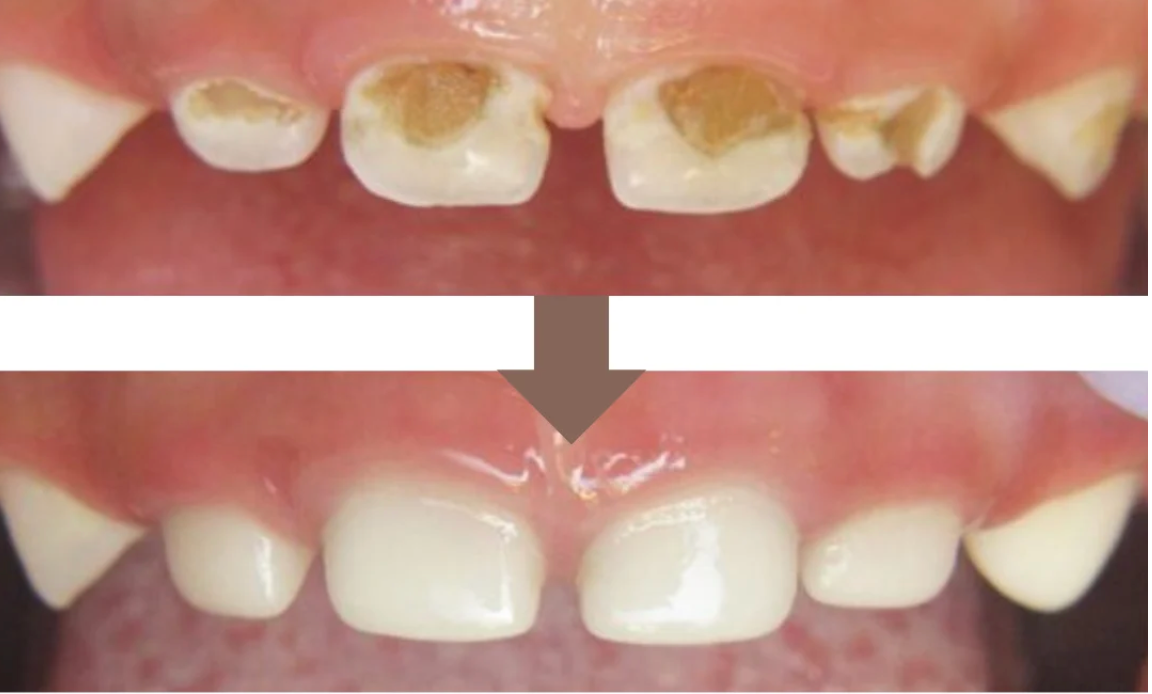
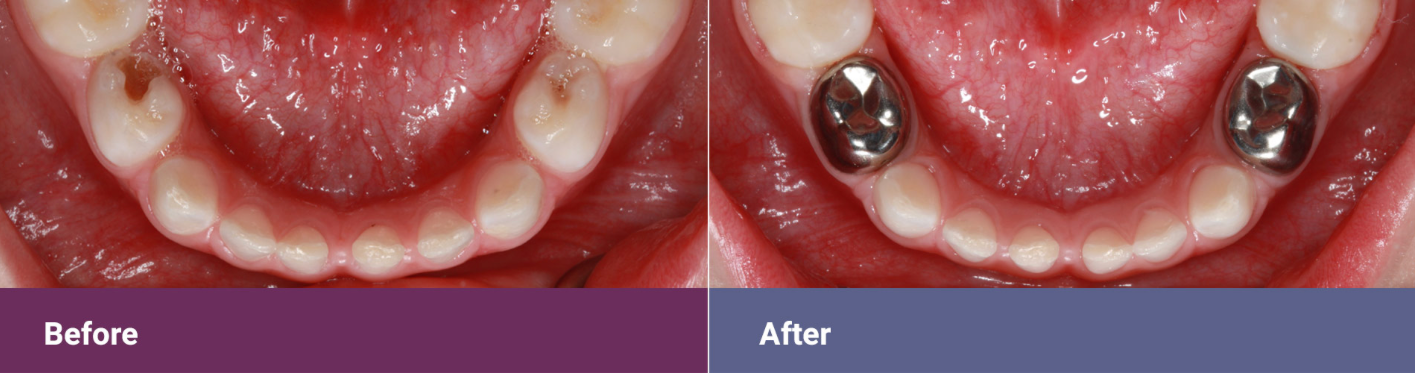
We use two kinds, and which one your child gets depends on which tooth needs it: tooth-colored composite crowns for front teeth, and stainless steel crowns for back molars.
When a crown is the right call
A filling works when there's enough healthy tooth left to hold it. Once decay has taken too much of the tooth, a filling has nothing solid to anchor to — it breaks, or decay creeps back in underneath.
We'll usually recommend a crown when:
- Decay is extensive, or covers several surfaces of the tooth
- A tooth has already had a filling that failed
- The nerve is involved and a pulpotomy or pulpectomy is needed — that tooth becomes brittle afterward and needs full coverage
- A tooth is cracked or broken, often after a fall
- Your child is at high risk of new decay, where a filling is likely to fail
- Treatment is being done under sedation and we want to avoid a repeat visit
Front teeth: tooth-colored composite crowns
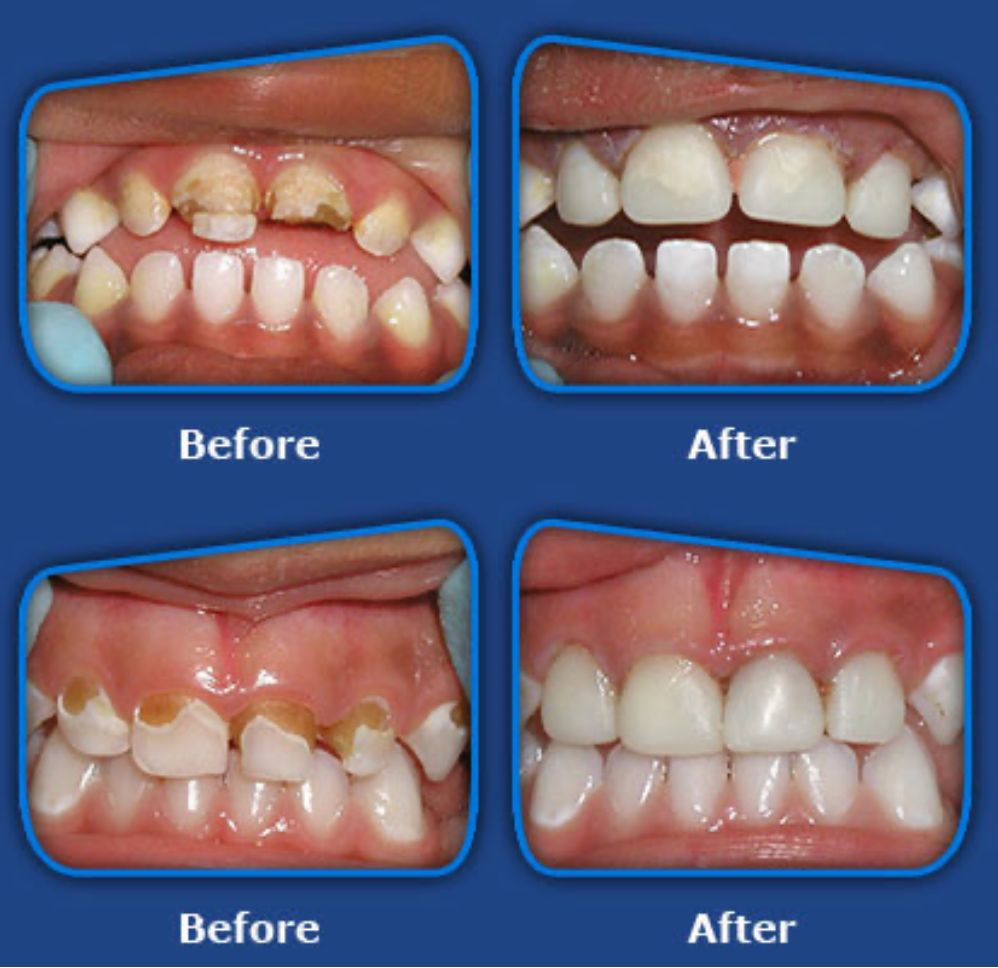
For front teeth, we place tooth-colored composite crowns.
Front teeth are what everyone sees, and they don't take the heavy grinding force that molars do — so a natural-looking crown is both possible and the right choice there. We build it from the same tooth-colored composite used for white fillings, shaped and shaded to match your child's own teeth.
The result looks like a tooth. For a child who's been self-conscious about a decayed or broken front tooth, that difference is not cosmetic — it's the whole point. Kids notice their own smiles, and so do their classmates.
Front-tooth crowns come up most often after decay in a young child's upper front teeth, or after a fall that chips or breaks one.
Back molars: stainless steel crowns
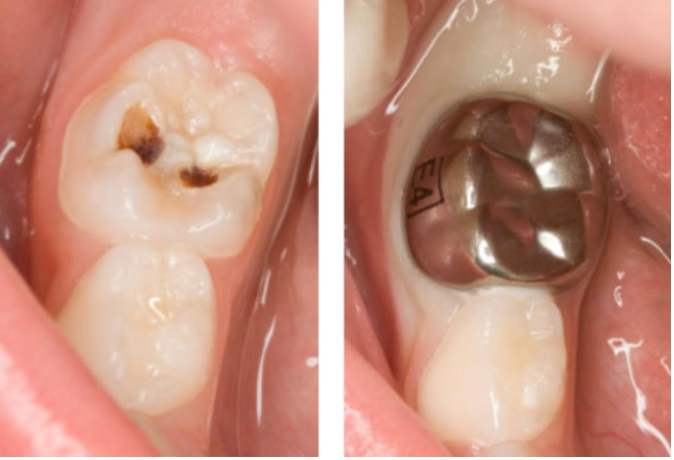
For back teeth, we use stainless steel crowns. Parents are sometimes taken aback by the silver, so here's the honest reasoning.
They hold up under real chewing force. Molars do the heavy work, and stainless steel handles it better than any tooth-colored material we could place on a baby molar. It's why these crowns have been the standard of care in pediatric dentistry for decades.
They protect the entire tooth. A filling repairs one part of a tooth. A crown covers all of it, leaving no exposed surface for new decay to start on.
They go on in one visit. No impressions, no temporary crown, no second appointment — which matters a great deal for a young or anxious child.
They're cost-effective and covered by most dental insurance plans.
They last as long as the tooth does. A well-placed stainless steel crown stays put until that baby molar falls out naturally, and comes out along with it.
On the appearance: they're silver and they don't blend in. But they sit on back molars, far enough back that they aren't visible when your child talks or smiles — you'll see them, we'll see them, most people won't. And baby molars are temporary by nature. If the look genuinely worries you, say so and we'll talk through what's possible for your child's specific tooth.
What the appointment is like
We look at the tooth together. We'll show you the x-ray and explain what we're seeing and why a filling won't hold.
We keep your child comfortable. Numbing gel first, then local anesthetic. Many children do well with nitrous oxide as well, and for longer treatment or a very anxious child we can talk about oral sedation or IV sedation in our office.
We remove the decay. If it has reached the nerve, we'll do a pulpotomy or pulpectomy at the same time — treating the inside of the tooth so it can stay in place comfortably.
We place the crown. For a back tooth, we select a stainless steel crown in the right size and shape it to fit the bite. For a front tooth, we build and shade the composite crown to match your child's other teeth.
We check the bite and polish everything smooth.
Start to finish, this is usually a single visit.
Afterward
- Watch the numb lip. This catches families out more than anything else. Children will chew a numb cheek or lip without feeling it, and the sore that follows hurts more than the dental work did. Keep an eye on them until sensation fully returns.
- Tenderness for a day or two is normal, especially in the gum around a new crown.
- Soft foods the first day, then back to normal.
- Skip sticky foods. Taffy, caramel, and chewy candy can pull at a crown. Honestly, worth a permanent household rule.
- Go easy on front-tooth crowns. Composite crowns look great but aren't built for biting into hard things — apples, corn on the cob, ice. Cut hard foods up, and no chewing on pencils or fingernails.
- Keep brushing and flossing exactly like a normal tooth. A crown can't decay, but the gum around it still needs care.
Call us if your child has pain that isn't settling after a couple of days, if the bite feels off, or if a crown ever feels loose.
Questions parents ask
Will it hurt?
The tooth is fully numb, so your child shouldn't feel pain during the appointment — pressure and movement, but not pain. Mild soreness afterward is normal and brief.
How long does a crown last?
Usually until the baby tooth falls out on its own. That's what they're designed for.
What happens when the tooth comes out?
The crown comes out with it. Nothing extra needs doing.
Why not just pull the tooth?
Baby teeth hold space for the permanent teeth coming in underneath. Take one out too early and neighboring teeth drift into the gap, which can crowd the adult tooth and cause orthodontic problems later. Front teeth also matter for speech and for how a child feels about their smile. Saving the tooth is almost always the better outcome.
Can my child have a white crown on a back tooth?
We generally don't recommend it. Tooth-colored crowns can be less durable under molar chewing forces, they can fracture easily and require a more aggressive removal of tooth structure and typically an unnecessary nerve treatment too. A crown that fails means another appointment and more dental work for your child - possibly even an extraction. If it's important to you, raise it and we'll talk it through for that specific tooth.
Is stainless steel safe?
Yes. These crowns have been used in children's dentistry for over fifty years with an excellent safety record. If your child has a known nickel allergy, tell us — it's uncommon, but we'd want to know beforehand.
We'll walk you through it
If we've recommended a crown for your child, ask us anything you're unsure about — including how it will look. You should understand and be comfortable with the plan before we start.
Call Bloom Pediatric Dentistry in Chandler: 480-867-7355